

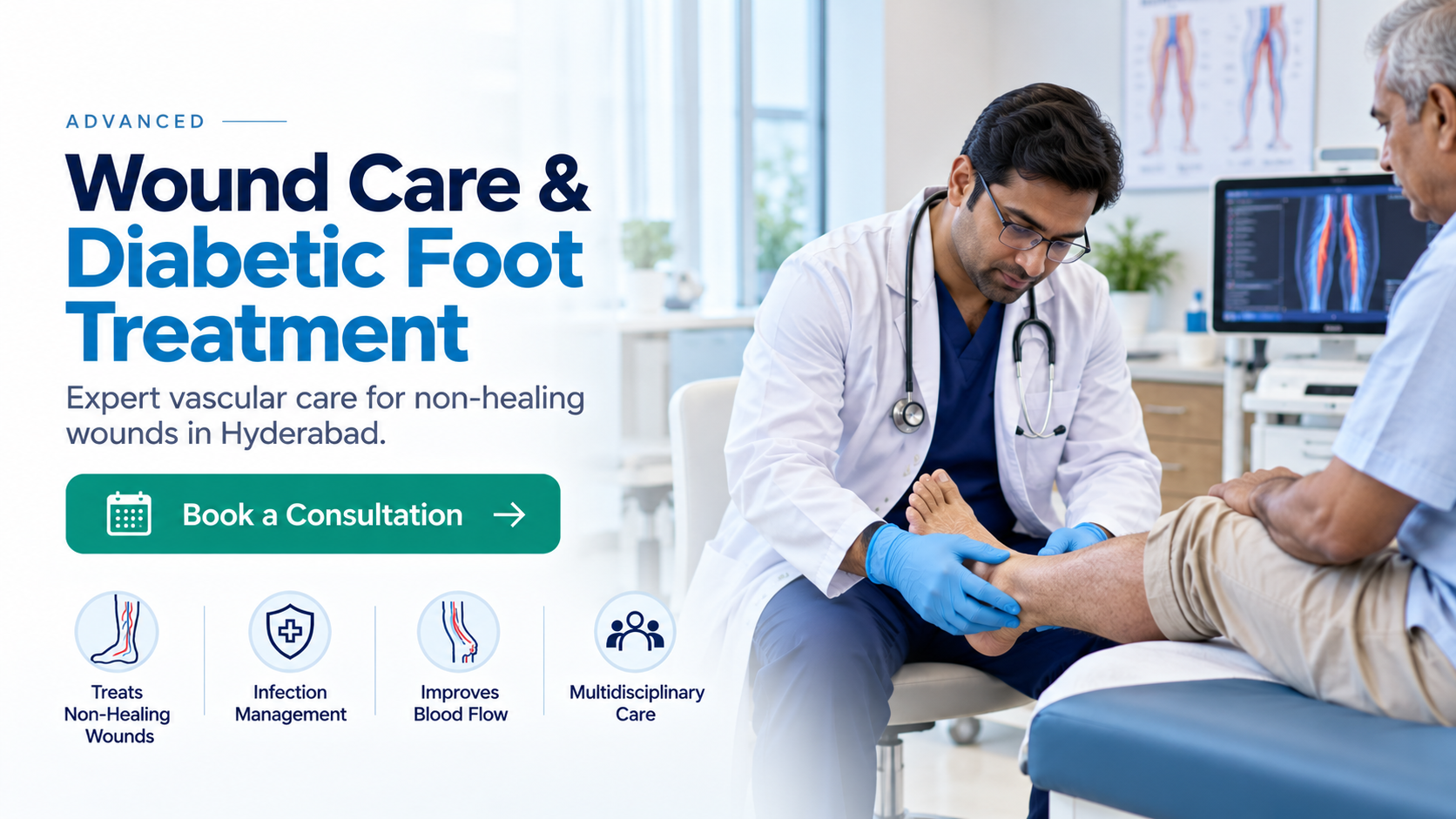
Chronic wound not healing? Diabetic foot ulcer getting worse? Blackening, infection, or poor circulation? Do not wait for a small wound to become a limb-threatening problem.
Asian Vascular Hospital in Banjara Hills, Hyderabad provides specialist vascular and advanced wound care for patients with diabetic foot ulcers, chronic non-healing wounds, poor circulation, gangrene, neuropathy-related injuries, and other complex lower-limb conditions.
If a wound is not healing despite regular dressing, the problem may not be the wound alone. Poor blood circulation, peripheral artery disease (PAD), diabetes-related neuropathy, infection, pressure, or tissue damage may be preventing healing.
Appointments: +91 81439 98831
Location: Road No. 12, Banjara Hills, Hyderabad.

Why Choose a Vascular Wound Care Specialist for a Non-Healing Wound?
A chronic wound may fail to heal when the underlying blood supply, infection, pressure, or nerve damage has not been addressed. Simply covering the wound with repeated dressings may not be enough if there is significant arterial disease or another underlying cause of poor healing.
A wound specialist with vascular expertise can evaluate the wound together with the circulation supplying the affected limb.
This is particularly important for people with diabetes because diabetic foot ulcers can involve multiple factors at the same time:
- Peripheral neuropathy and reduced sensation
- Peripheral artery disease and reduced blood flow
- Repeated pressure or friction
- Infection
- Tissue death or gangrene
- Foot deformity
- Poor wound-healing capacity
The IWGDF recommends assessing peripheral artery disease and other causes of poor healing in people with diabetes who have a foot ulcer or gangrene.
Why General Wound Dressing May Not Be Enough
A dressing protects a wound, but it does not necessarily correct the reason the wound developed or why it is failing to heal.
For example:
Blocked artery → reduced blood flow → inadequate tissue perfusion → delayed healing
Neuropathy → reduced sensation → unnoticed injury → repeated pressure → ulcer
Infection → tissue damage → wound deterioration
Effective wound management therefore starts with understanding the underlying cause.
What Conditions Does Asian Vascular Hospital Treat?
Asian Vascular Hospital provides vascular and wound-focused care for diabetic foot ulcers, chronic wounds, circulation-related wounds, and other conditions affecting healing. Its published treatment services include diabetic foot ulcer care, peripheral artery disease, peripheral neuropathy, wound healing and limb salvage.
Diabetic Foot Ulcers
Diabetic foot ulcers are open wounds that can develop because of a combination of neuropathy, pressure, foot deformity, trauma, infection, and poor circulation.
Because neuropathy may reduce the ability to feel pain, a small blister, cut, or pressure injury can remain unnoticed and worsen over time.
Treatment depends on the ulcer’s depth, infection status, pressure, circulation, and overall health of the foot.
Neuropathy-Related Foot Wounds
Diabetic neuropathy can reduce protective sensation in the feet.
A person may not notice:
- A blister caused by footwear
- A small cut
- A burn
- Repeated pressure
- A developing ulcer
- An object inside a shoe
When sensation is reduced, regular foot inspection and professional assessment become particularly important.
Venous Leg Ulcers
Venous ulcers are commonly associated with problems in the veins of the leg, including venous reflux and chronic venous hypertension.
They often occur around the lower leg and ankle and may be associated with swelling, skin changes, varicose veins, and recurrent wounds.
Treatment requires identifying the underlying venous problem rather than treating the ulcer in isolation.
Arterial Ulcers Caused by PAD
Arterial ulcers can develop when blood flow through the arteries supplying the leg and foot is significantly reduced.
Peripheral artery disease can cause inadequate tissue perfusion, making wounds difficult to heal.
In people with diabetes and a foot ulcer or gangrene, vascular assessment is particularly important because PAD may be present without obvious symptoms.
Post-Surgical or Traumatic Non-Healing Wounds
Some wounds may remain open or heal slowly following surgery, trauma, or another injury.
When healing is delayed, doctors may need to assess factors such as:
- Blood circulation
- Infection
- Tissue viability
- Pressure
- Diabetes control
- Nutritional and systemic factors
The appropriate treatment depends on the underlying cause.
What Are the Warning Signs of a Non-Healing Diabetic Foot?
A diabetic foot should be assessed when a wound is not healing normally or when there are changes suggesting infection, tissue damage, or inadequate blood flow.
Watch for:
- A wound that remains open
- Increasing redness
- Swelling
- Pus or discharge
- Foul smell
- Increasing warmth around the wound
- Blackening of a toe or part of the foot
- Skin colour changes
- New or worsening numbness
- Increasing pain
- Coldness of the foot
- Gangrene
- Fever or feeling unwell
Do not rely on pain alone. Neuropathy can reduce sensation, meaning a serious diabetic foot problem may develop with little pain.
If a wound is rapidly worsening, turning black, producing foul-smelling discharge, or accompanied by systemic symptoms, seek urgent medical attention.
How Is a Non-Healing Wound Evaluated?
The first step is to determine why the wound is not healing. This requires assessment of the wound itself as well as the nerves, blood vessels, infection status, and surrounding tissue.
Depending on the patient, evaluation may include:
Wound Assessment
The doctor evaluates:
- Location
- Size
- Depth
- Tissue condition
- Drainage
- Signs of infection
- Surrounding skin
- Pressure points
Neuropathy Assessment
Sensation may be assessed to determine whether diabetic neuropathy is contributing to unnoticed injury or repeated pressure.
Vascular Assessment
Blood flow may need to be evaluated using clinical examination and vascular testing.
Depending on the case, this may include:
- Pulse examination
- Doppler or duplex ultrasound
- Ankle-brachial index
- CT angiography
- Other vascular imaging when clinically indicated
The IWGDF recommends evaluating PAD and other causes of poor healing in people with diabetes and a foot ulcer or gangrene.
Infection Assessment
If infection is suspected, the wound may require further evaluation and appropriate infection management.
Deep or severe infections may require more extensive treatment, including surgical intervention when indicated.
What Diabetic Wound Treatment Is Available?
Treatment is individualised according to the wound, circulation, infection, tissue viability, and overall condition of the patient.
Depending on the clinical situation, treatment may include wound care, debridement, infection management, pressure offloading, vascular intervention, or limb-salvage procedures.
Advanced Wound Management
Wound management may involve appropriate dressings, wound cleaning, monitoring, pressure management, and removal of non-viable tissue when clinically indicated.
The objective is to create an environment that supports healing while addressing the underlying cause of the wound.
Debridement
Debridement involves removing dead, damaged, or infected tissue when medically appropriate.
It may be an important part of managing wounds with non-viable tissue or infection.
The extent and type of debridement depend on the wound and the patient’s condition.
Infection Management
An infected diabetic foot requires timely medical assessment.
Treatment may involve appropriate antibiotics when infection is present, wound management, drainage of collections, and surgical removal of infected or non-viable tissue when required.
Severe infections require urgent assessment because infection can spread into deeper tissues.
Pressure Offloading
Pressure can prevent a diabetic foot ulcer from healing, particularly when neuropathy is present.
Appropriate offloading or protective footwear may be recommended depending on the location and characteristics of the ulcer.
Simply changing footwear without professional assessment may not be enough for an established ulcer.
How Does Vascular Treatment Help a Non-Healing Diabetic Foot?
When significant arterial disease is limiting blood flow to the foot, restoring circulation may be an important part of treatment.
Angioplasty and other revascularisation procedures can be used in appropriately selected patients to improve blood flow through narrowed or blocked arteries.
The 2024 ACC/AHA PAD guideline recommends revascularisation to prevent limb loss in patients with chronic limb-threatening ischemia.
At Asian Vascular Hospital, published treatment information includes angioplasty and AngioJet therapy, along with wound management for diabetic foot conditions.
The appropriate vascular procedure depends on:
- Location of the blockage
- Severity of arterial disease
- Blood flow to the foot
- Wound characteristics
- Tissue viability
- Overall health
- Individual treatment goals
Not every diabetic foot ulcer requires angioplasty. The decision should follow appropriate vascular assessment.
What Is Limb Salvage?
Limb salvage is a treatment approach focused on preserving viable tissue and avoiding unnecessary major amputation when medically possible.
It is not a single procedure.
Depending on the patient’s condition, limb-salvage care may combine:
Vascular assessment → Blood-flow restoration when indicated → Infection control → Debridement → Pressure offloading → Wound care → Follow-up
For patients with diabetes, PAD, infection, tissue loss, or gangrene, several of these components may be required.
The IWGDF/ESVS/SVS PAD guidance emphasises assessment of PAD and healing potential in people with diabetes who have foot ulcers or gangrene.
Why Choose Asian Vascular Hospital in Hyderabad?
Asian Vascular Hospital is a specialist vascular centre located in Banjara Hills, Hyderabad, with services including diabetic foot ulcer care, PAD management, wound healing and limb salvage.
Vascular Leadership
The hospital’s published doctor profile identifies Dr. G.V. Praveen Kumar, MS, DNB (Vascular Surgery) as its Founder Chairman and Chief Consultant, with more than 20 years of vascular experience and expertise including diabetic foot management, endovascular interventions and limb-salvage procedures.
Endovascular Expertise
The hospital’s published clinical specialisations include:
- Peripheral arterial disease management
- Angioplasty
- Thrombectomy
- Embolisation
- Diabetic foot management
- Limb-salvage procedures
- Wound healing
- Vascular reconstruction
Advanced Vascular Infrastructure
The hospital’s doctor profile states that hybrid operation theatres and Cathlab facilities were introduced as part of its vascular infrastructure.
This infrastructure supports the evaluation and treatment of vascular conditions requiring endovascular or surgical approaches.
A Vascular Approach to Wound Healing
The key difference is that a vascular-focused wound evaluation looks beyond the wound surface.
Instead of asking only:
“How do we dress this wound?”
the evaluation also asks:
“Why is this wound not healing?”
That distinction can be important when circulation, neuropathy, infection, pressure, or tissue loss is involved.
Looking for a Wound Care Specialist Near You in Hyderabad?
If you are searching for a wound care specialist near me, wound care specialist doctor near me, or a wound specialist for a chronic diabetic foot or non-healing leg wound, choosing a centre with vascular expertise can be particularly relevant when poor circulation may be contributing to delayed healing.
Asian Vascular Hospital is located at:
8-2-676 2/B, Road No. 12,
Sri Ram Nagar Colony, Banjara Hills,
Hyderabad, Telangana – 500034
Appointments: +91 81439 98831
The hospital’s published opening hours are 9:00 AM–5:00 PM daily.
Patients may travel from areas including Jubilee Hills, Gachibowli, Madhapur, Secunderabad, and other parts of Hyderabad for specialist vascular evaluation.
Patient Experiences
Patient feedback can provide useful context, but individual outcomes vary and testimonials should never be interpreted as a guarantee of treatment results.
Asian Vascular Hospital publishes patient experiences relating to diabetic foot and wound care on its website. These include accounts describing non-healing wounds and treatment focused on wound management and limb preservation.
For the final published page, use verified patient testimonials with documented consent rather than adding anonymous or unverified claims.
When Should You Seek Urgent Diabetic Foot Care?
Do not wait for a routine appointment if a diabetic foot problem is rapidly deteriorating.
Seek urgent medical assessment if you notice:
- Blackening of a toe or foot
- Gangrene
- Rapidly spreading redness
- Severe swelling
- Foul-smelling discharge
- Significant tissue loss
- A rapidly worsening ulcer
- Fever or systemic illness
- Severe foot pain
- A cold or markedly discoloured foot
- Sudden deterioration of an existing wound
Severe infection, extensive gangrene, or severe ischemia can require urgent surgical and vascular assessment.
Frequently Asked Questions
- All Post
- blog




Related posts:
 Vascular Surgeon Vijayawada – Advanced Care by Dr. G.V. Praveen Kumar
 Early Stage Diabetic Foot Ulcer – Catch It Before It Gets Serious
 🧠 Peripheral Neuropathy Test – Detect Nerve Damage Early & Protect Your Health
 Laser Treatment for Varicose Veins Near Me – Asian Vascular Hospitals
 🌟 Best Treatment for Peripheral Neuropathy – Asian Vascular Hospitals
 Vascular Surgeon in Medchal: Advanced Care for Healthy Circulation
 Diabetic Foot Shoes: Comfort & Protection for Every Step
 👣 Podiatrist Hyderabad – Expert Foot & Ankle Care at Asian Vascular Hospitals