

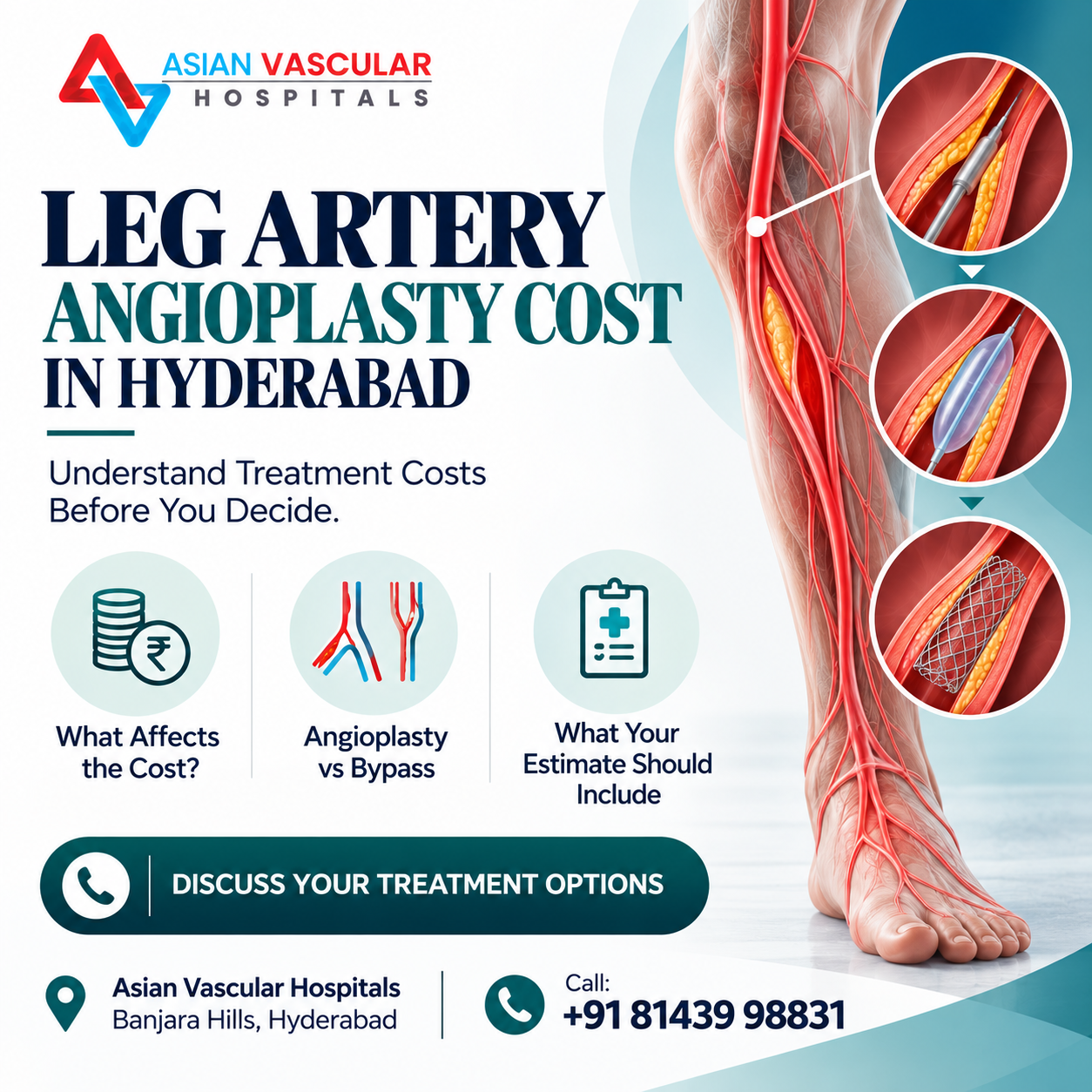
How Much Does Leg Artery Angioplasty Cost in Hyderabad?
If you have been diagnosed with a narrowed or blocked leg artery, one of your first questions may be how much angioplasty will cost and what the treatment involves.
The cost of leg artery angioplasty in Hyderabad depends on the patient’s condition, the location and complexity of the blockage, the devices required, hospital charges and recovery needs. There is no single price that accurately applies to every patient.
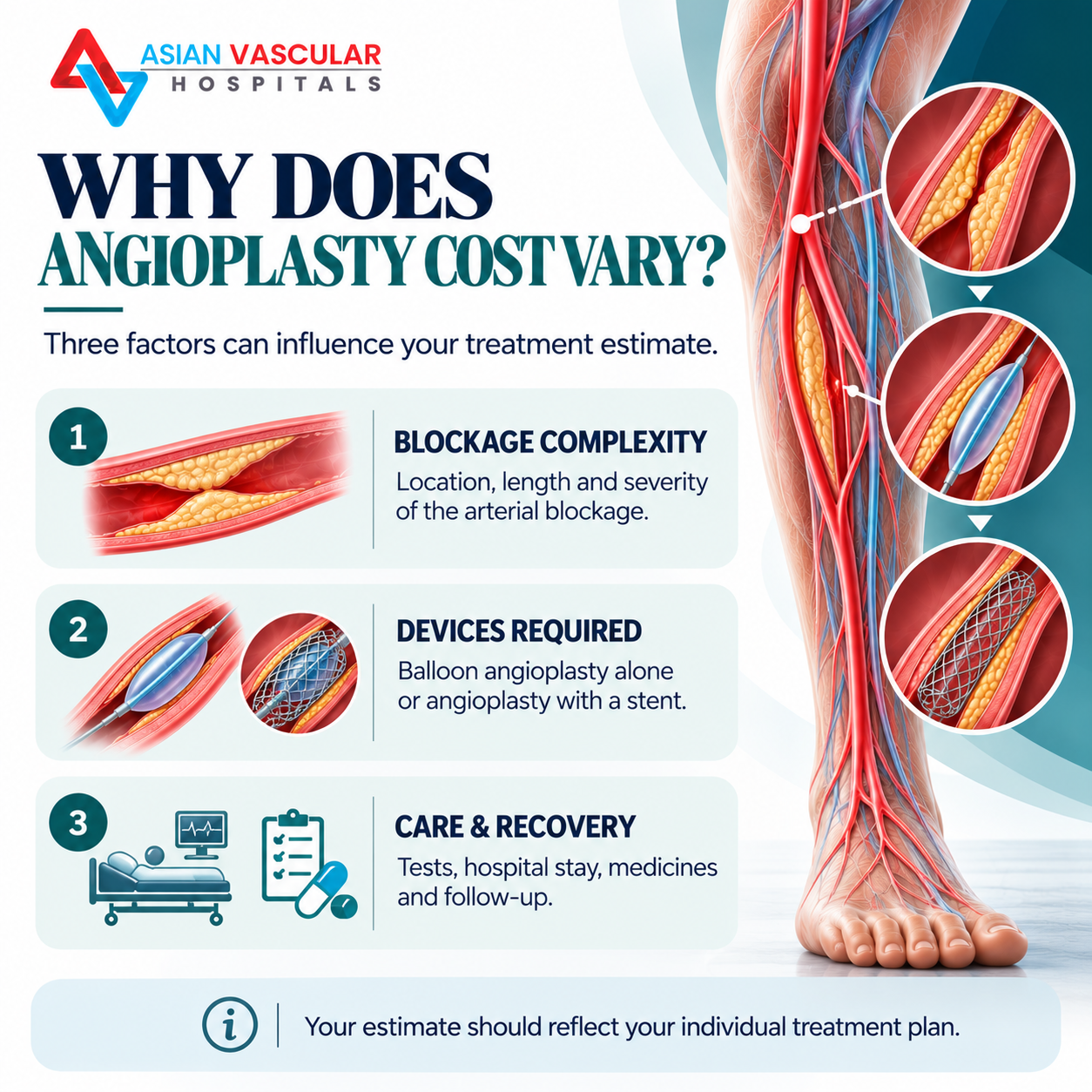
A straightforward procedure involving one arterial narrowing may require different resources from a complex intervention involving multiple blockages, additional stents or severely reduced blood circulation.
At Asian Vascular Hospitals in Banjara Hills, Hyderabad, patients considering vascular treatment should request an individualised estimate based on their diagnosis and proposed treatment plan. Confirm the current procedure charges and inclusions directly with the hospital rather than relying on a general online price.
This guide explains the main factors affecting peripheral angioplasty cost, what a written estimate should include, and how angioplasty differs from bypass surgery.
What Is Leg Artery Angioplasty?
Leg artery angioplasty is a minimally invasive procedure used to widen a narrowed or blocked artery and improve blood flow to the leg or foot.
It is commonly considered for selected patients with peripheral artery disease (PAD), a condition in which arteries become narrowed, often because of atherosclerosis.
During the procedure, a vascular specialist guides a thin catheter through a blood vessel to the affected area. A small balloon is inflated to widen the narrowed section of the artery. Depending on the location and characteristics of the blockage, a stent may also be placed to help keep the artery open.
The treatment approach depends on the patient’s arterial anatomy, symptoms, overall health and clinical goals.
Angioplasty is not necessary for everyone with PAD. Depending on the severity of symptoms, treatment may involve medication, cardiovascular risk management, structured exercise and monitoring. A procedure may be considered when the expected benefits justify the risks.
For a broader overview, visit our peripheral artery disease treatment service in Hyderabad.
What Factors Affect Leg Artery Angioplasty Cost in Hyderabad?
Several factors influence the final cost. Understanding these factors can help you ask more useful questions when comparing treatment estimates.
1. Location of the Blocked Artery
The location of the blockage can affect the equipment, techniques and time required for the procedure.
For example, blockages in the iliac arteries near the pelvis may require a different approach from blockages in the femoral, popliteal or smaller arteries supplying the lower leg and foot.
The length, severity and distribution of the disease are also important. Some patients have a single narrowed segment, while others have several affected arteries.
The number and location of blockages matter more than the procedure name alone when estimating complexity.
2. Severity and Complexity of the Blockage
Not all arterial blockages are equally difficult to treat.
The procedure may be more complex when an artery is completely blocked, the affected segment is long, the vessels are heavily calcified, or the blockage is difficult to cross with a catheter.
Complex cases may require additional imaging, specialised wires or catheters, more procedure time, or a different revascularisation strategy.
The vascular specialist assesses these factors before recommending the most appropriate approach.
3. Whether a Stent Is Required
Balloon angioplasty does not always require a stent.
In some cases, balloon treatment alone may be appropriate. In others, a stent or another device may be needed based on the arterial location, the result after balloon treatment and the characteristics of the lesion.
A stent can add to the overall procedure cost because of the device itself and any additional equipment or steps required.
When discussing the estimate, ask whether the proposed plan includes a stent and whether the cost would change if the final procedure requires additional devices.
4. Diagnostic Tests and Imaging
Before angioplasty, the medical team may need investigations to confirm the diagnosis and plan treatment.
Depending on the patient’s condition, these may include:
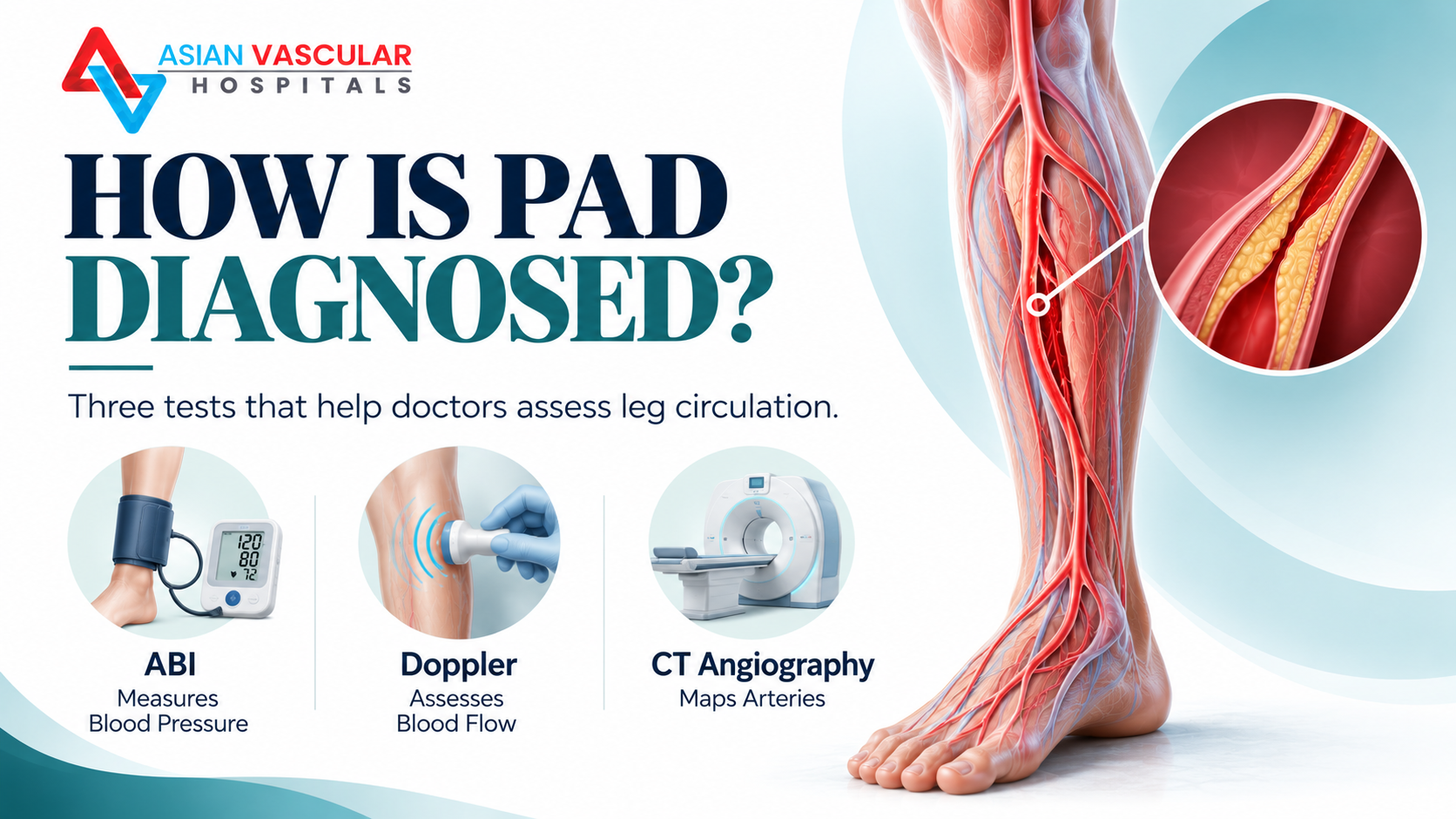
- Ankle-brachial index (ABI) testing.
- Arterial Doppler or duplex ultrasound.
- CT angiography or another vascular imaging study.
- Blood tests and kidney function assessment.
- Heart or anaesthesia evaluation when clinically indicated.
Some investigations may already have been completed, while others may be needed before the procedure. Ask which tests are included in the estimate and which are charged separately.
Learn more about PAD diagnosis tests, including ABI, Doppler ultrasound and CT angiography.
5. Hospital Stay and Recovery Requirements
The length of hospital stay depends on the procedure, the patient’s general health and whether complications or additional treatment are needed.
Some patients may require a relatively short stay, while others need longer observation or inpatient care.
The overall cost may include:
- Room or bed charges.
- Nursing and monitoring.
- Medicines and consumables.
- Laboratory tests.
- Additional consultations.
- Intensive monitoring when clinically necessary.
- Treatment of complications, if they occur.
Ask whether the quoted amount covers the expected stay and how additional days would be billed.
6. Patient Health and Existing Medical Conditions
Conditions such as diabetes, kidney disease, heart disease and complex vascular disease can affect treatment planning and recovery.
For example, kidney function may influence the use of contrast material during imaging or angioplasty. Patients with diabetic foot wounds or severely reduced circulation may also require wound care, infection management or other coordinated treatment.
These additional needs can affect the overall treatment expense, although the extent varies from patient to patient.
7. Medicines and Follow-Up Care
The cost of treatment does not necessarily end when the angioplasty is completed.
After the procedure, the treating clinician may prescribe medicines and arrange follow-up assessments to monitor symptoms, wound healing and circulation.
Depending on the patient’s condition, follow-up may involve clinical examinations, vascular ultrasound or other investigations.
Ask whether discharge medicines, follow-up consultations and any planned monitoring are included in the estimate.
What Should a Written Angioplasty Estimate Include?
Before proceeding with treatment, request a written estimate that explains what is included and what may be charged separately.
Use the following checklist when discussing the proposed treatment with the hospital.
| Cost component | What to clarify |
|---|---|
| Professional fees | Are the vascular specialist’s and other relevant professional fees included? |
| Procedure and facility charges | Are the procedure room, equipment and facility charges included? |
| Balloons, stents and devices | Which devices are anticipated, and how are additional devices charged? |
| Diagnostic investigations | Are imaging, blood tests and pre-procedure assessments included? |
| Anaesthesia and monitoring | Are applicable anaesthesia or sedation charges included? |
| Hospital stay | How many days are estimated, and what are the additional-day charges? |
| Medicines and consumables | Are procedure-related medicines and consumables included? |
| Follow-up | Are follow-up consultations and planned tests included? |
| Additional treatment | How would the estimate change if the treatment plan needs to be modified? |
| Insurance and payment | Is cashless treatment available under your policy, and what exclusions or approvals apply? |
A written estimate should also state its validity period, payment terms and any important exclusions.
An estimate is not necessarily a guarantee of the final bill. The clinical findings during treatment, unexpected complications or a change in the required procedure can affect the total expense. Ask the hospital how such changes are communicated and approved.
Leg Artery Angioplasty Cost vs Leg Stenting Cost
People often use the terms angioplasty and stenting interchangeably, but they are not exactly the same.
Angioplasty refers to widening a narrowed artery, commonly using a balloon. Stenting involves placing a small mesh-like device inside the artery to help maintain its opening when indicated.
A procedure may involve balloon angioplasty alone or angioplasty with one or more stents. Therefore, the cost of leg stenting can differ from the cost of a procedure that does not require a stent.
When requesting an estimate, ask:
- Is balloon angioplasty planned?
- Is a stent likely to be needed?
- What type and number of devices are anticipated?
- Are the device costs included in the quoted amount?
- Could the plan change after the artery is assessed during the procedure?
The final approach should be based on clinical need rather than the desire to choose the lowest-cost device or procedure.
Angioplasty vs Bypass Surgery: Which Is More Cost-Effective?
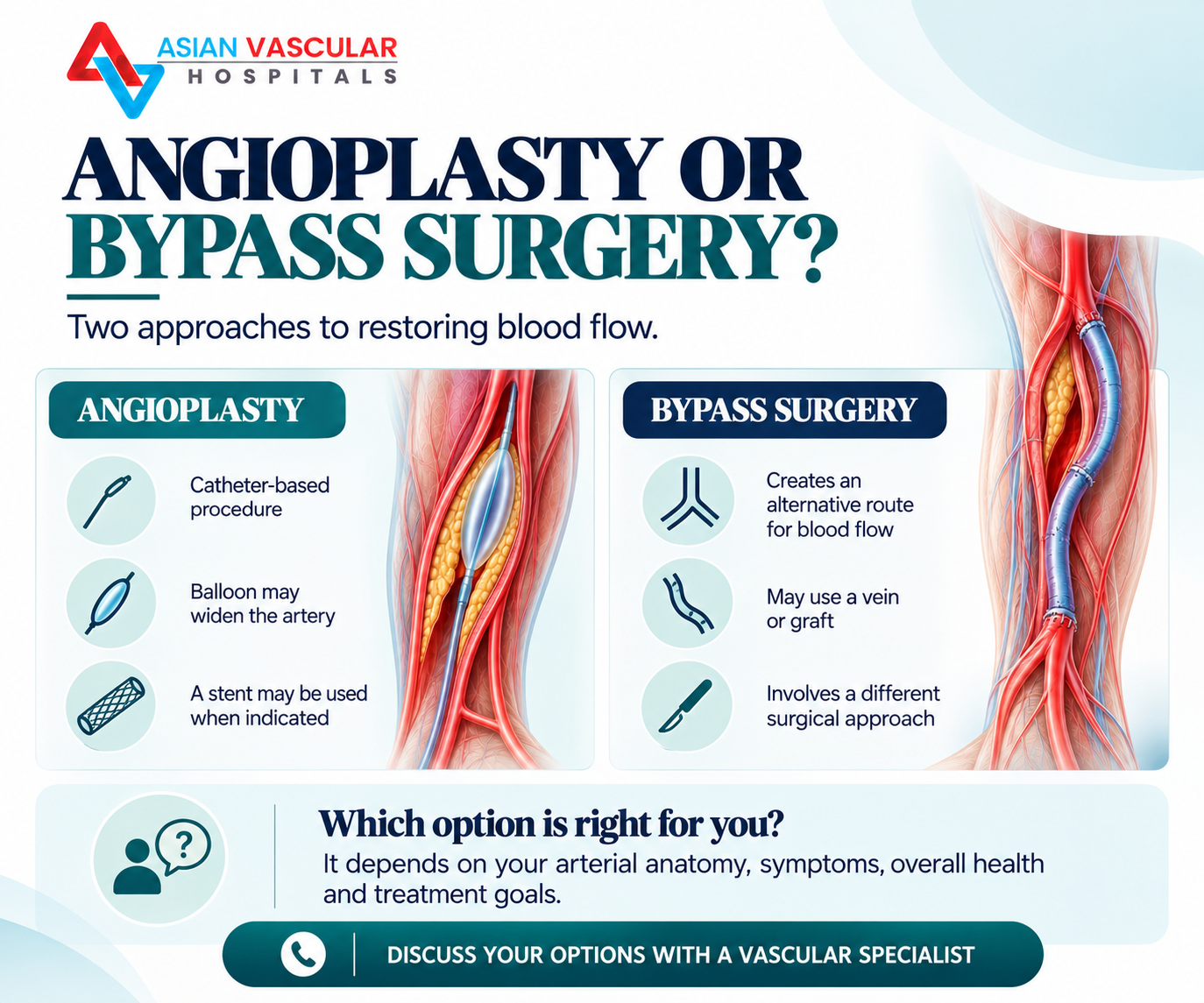
Angioplasty and bypass surgery are two different approaches to restoring blood flow around an arterial blockage. Neither is automatically the best option for every patient.
Angioplasty
Angioplasty is performed through a catheter inserted into a blood vessel. It usually avoids the larger surgical incisions associated with open bypass surgery.
Potential considerations include:
- A less invasive approach in suitable cases.
- Recovery and hospital stay that may be shorter in some patients.
- Possible additional costs for balloons, stents or other devices.
- A risk of recurrent narrowing or the need for repeat intervention.
Leg Artery Bypass Surgery
Bypass surgery creates an alternative route for blood to flow around the blocked artery, using an appropriate blood vessel or graft.
Potential considerations include:
- A larger surgical procedure and incision.
- Different anaesthesia, hospital stay and recovery requirements.
- The need to assess whether a suitable vein or graft is available.
- Potentially durable results in selected patients.
- Surgical risks and the possibility of future procedures.
| Consideration | Angioplasty | Bypass surgery |
|---|---|---|
| How it works | Widens the narrowed artery using a catheter-based technique | Creates an alternative route around the blockage |
| Surgical access | Usually through a small access site | Usually involves surgical incisions |
| Devices or grafts | May require balloons, stents or other devices | May require a vein or synthetic graft |
| Recovery | Often less invasive, depending on the case | May involve a longer recovery, depending on the operation and patient |
| Suitability | Depends on arterial anatomy, disease pattern and clinical goals | Depends on arterial anatomy, surgical risk and availability of a suitable conduit |
| Cost considerations | Device costs and procedural complexity | Surgical, graft, inpatient and recovery-related costs |
A less invasive procedure is not automatically cheaper overall, and bypass surgery is not always more expensive in every situation. The total expense depends on the specific treatment plan, hospital charges, recovery and the possibility of future interventions.
The 2024 ACC/AHA guideline recommends individualised decisions about revascularisation based on the patient’s symptoms, anatomy, risks, goals and likely benefit. For selected patients with lifestyle-limiting claudication, revascularisation may be considered when appropriate medical treatment and structured exercise have not adequately improved symptoms. For chronic limb-threatening ischemia, restoring blood flow is an important part of care when appropriate.
Read more about peripheral vascular surgery in Hyderabad.
Is Angioplasty Always Necessary for a Blocked Leg Artery?
No. The presence of a narrowed artery does not automatically mean a patient needs angioplasty.
The decision depends on symptoms, the severity and location of arterial disease, the effect on daily activities, the presence of wounds or tissue damage, and the patient’s overall health.
For some people with PAD, medical management, risk-factor control and structured exercise are the initial approach. Angioplasty or bypass may be considered when symptoms remain significantly limiting despite appropriate treatment or when limb-threatening circulation problems require revascularisation.
A vascular specialist should explain the expected benefits, risks, alternatives and likely need for follow-up before treatment is chosen.
Do not choose or delay a procedure based only on an online cost estimate. The appropriate treatment must be determined through clinical assessment.
Does Insurance Cover Leg Artery Angioplasty?
Insurance coverage depends on your policy, the medical indication, the insurer’s terms and the hospital’s arrangements with the insurer.
Before admission, ask your insurer and hospital to clarify:
- Whether the proposed procedure is covered.
- Whether pre-authorisation is required.
- Whether the hospital is within your policy’s network.
- Which devices, investigations and hospital charges are covered.
- Whether there are co-payments, deductibles, sub-limits or exclusions.
- What documentation is needed for reimbursement if cashless approval is unavailable.
Do not assume that the entire bill will be covered simply because the procedure is medically necessary. Request written confirmation of the applicable approval and exclusions where possible.
Questions to Ask Before Agreeing to Angioplasty
A cost discussion should help you understand both the financial commitment and the clinical plan.
Consider asking the treating team:
- Where exactly is the blocked artery, and how severe is the blockage?
- Why is angioplasty recommended in my case?
- Are medication and structured exercise appropriate alternatives, or is revascularisation needed?
- Is a stent likely to be required?
- Would bypass surgery be a reasonable alternative?
- What are the expected benefits and the main risks?
- What is included in the written estimate?
- Which additional costs may arise if the treatment plan changes?
- What medicines and follow-up tests may be needed after the procedure?
- How will insurance approval and billing be handled?
These questions can help you make an informed decision with your healthcare team rather than comparing hospitals on the headline price alone.
Leg Artery Angioplasty in Hyderabad: Getting a Treatment Estimate
If you have been diagnosed with PAD or a blocked leg artery, the first step is to understand the location and severity of the disease and whether a procedure is appropriate.
Asian Vascular Hospitals is located in Banjara Hills, Hyderabad, and provides vascular and endovascular care. Patients considering leg artery angioplasty should contact the hospital directly to discuss their clinical evaluation, proposed treatment and current charges.
Hospital: Asian Vascular Hospitals
Location: Banjara Hills, Hyderabad
Phone: +91 81439 98831
When contacting the hospital, ask whether a consultation and review of your existing investigations can help determine the likely treatment pathway and what information is needed to prepare a written estimate. Confirm the current fees and service availability directly with the hospital.
For an overview of the condition and available care, visit the peripheral artery disease treatment page.
Frequently Asked Questions
- All Post
- blog

Related posts:
 Trusted Vascular Hospital in Hyderabad: Where Advanced Care Meets Compassion
 Best Vascular Surgeon Near Me – Expert Care at Asian Vascular Hospitals
 Surgical Treatment for Varicose Veins – Walk Pain-Free Again
 Peripheral Neuropathy Doctors Near Me: How to Find the Right Specialist
 Best Vascular Surgeon in Warangal: Advanced Vascular Care You Can Trust
 Vascular Surgeon in Vikarabad: Advanced Care for Vein & Artery Health
 👣 Diabetic Foot Ulcer Treatment – Save Limbs with Expert Care at Asian Vascular Hospitals
 👣 Foot Specialist Doctor in Hyderabad – Expert Foot & Vascular Care at Asian Vascular Hospitals