

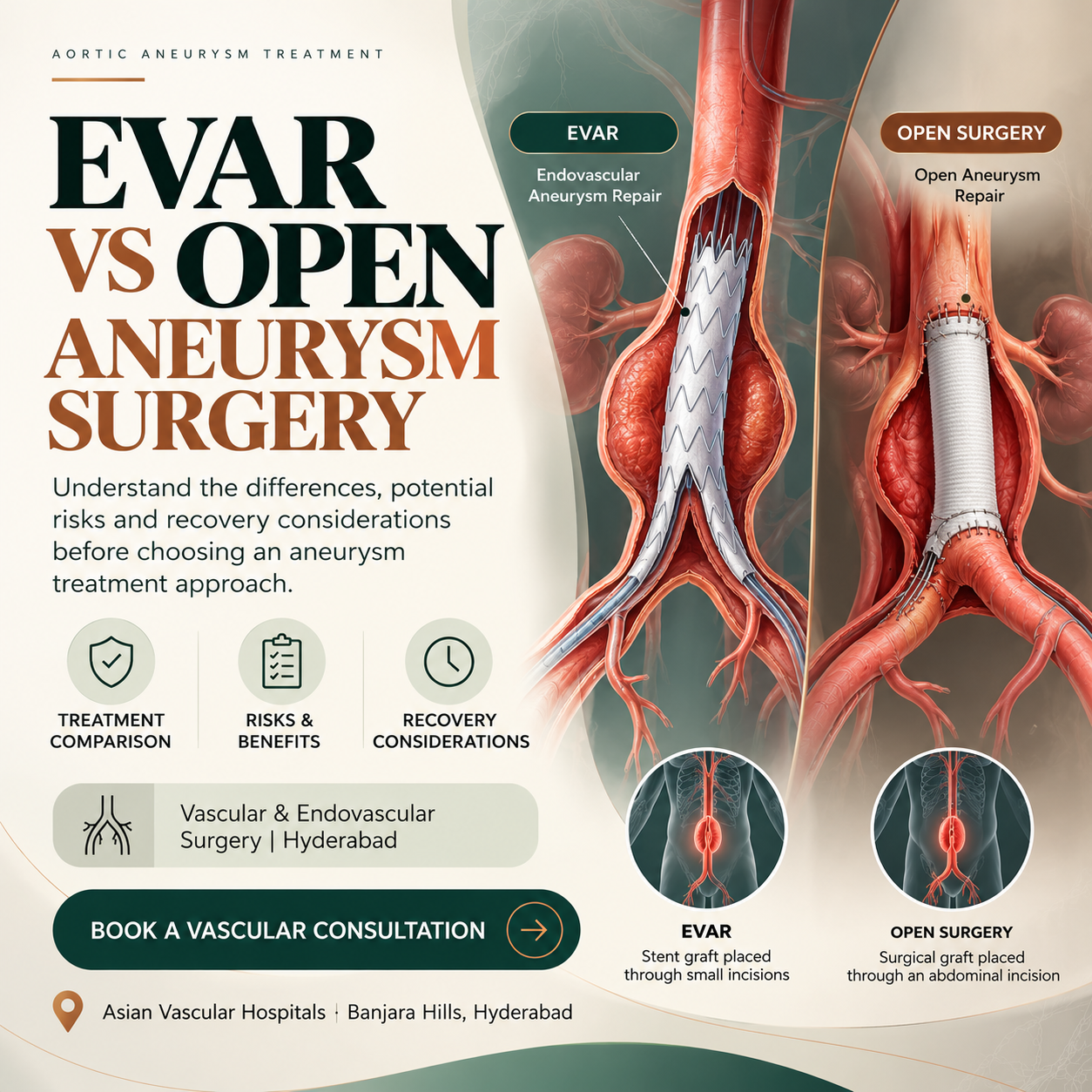
An aneurysm diagnosis can raise an important question: Is minimally invasive EVAR the right option, or is open aneurysm surgery more suitable? The answer depends on the aneurysm’s location and shape, the patient’s overall health, the anatomy of the blood vessels and the long-term risks of each approach.
Both endovascular aneurysm repair (EVAR) and open surgical repair are established treatment options for selected abdominal aortic aneurysms. EVAR uses a stent graft delivered through blood vessels, while open surgery involves directly accessing the aorta and replacing or reinforcing the affected section with a surgical graft.
Neither procedure is automatically the best choice for everyone. A vascular specialist evaluates the scans, explains the potential benefits and risks, and helps the patient make an informed decision.
At Asian Vascular Hospitals in Banjara Hills, Hyderabad, patients can seek specialist evaluation for aneurysm diagnosis and treatment planning.
Looking for aneurysm treatment in Hyderabad? Explore aneurysm treatment options or call +91 81439 98831 to enquire about an appointment.
Quick Comparison: EVAR vs Open Aneurysm Surgery
| Feature | EVAR | Open aneurysm surgery |
|---|---|---|
| Full form | Endovascular aneurysm repair | Open surgical aneurysm repair |
| How it works | A stent graft is delivered through an artery, usually via the groin. | The surgeon accesses the affected aorta through an incision and places a surgical graft. |
| Incisions | Usually small groin incisions or punctures. | A larger abdominal incision for abdominal aortic aneurysm repair. |
| Early recovery | Often shorter for suitable patients. | Generally longer because it is a major operation. |
| Hospital stay | Often shorter, depending on the patient’s condition. | Often longer, depending on recovery and complications. |
| Anatomical suitability | Requires suitable blood vessel anatomy and device fit. | Can be suitable when endovascular anatomy is unsuitable. |
| Long-term monitoring | Lifelong follow-up imaging is generally needed. | Follow-up remains important; the schedule differs from EVAR. |
| Main consideration | Less invasive approach, balanced against endoleak and reintervention risks. | More invasive initial operation, balanced against durability and individual surgical risks. |
Swipe horizontally to compare all columns →
This table describes general differences, not a prediction of an individual outcome. Hospital stay, recovery, risks and suitability vary from patient to patient.
What Is an Aortic Aneurysm?
The aorta is the main artery that carries blood from the heart to the rest of the body. An aortic aneurysm develops when part of the aortic wall weakens and expands abnormally.
An aneurysm can develop in the abdomen, known as an abdominal aortic aneurysm (AAA), or in the chest, known as a thoracic aortic aneurysm.
Some aneurysms remain stable for a long time and require regular monitoring. Others may need treatment because of their size, growth rate, symptoms, location or other clinical risk factors.
Many aortic aneurysms do not cause obvious symptoms. They may be detected during imaging performed for another reason. When an aneurysm is suspected, ultrasound or CT angiography may be used to assess its size and anatomy.
Aneurysm treatment is not based on size alone. The specialist considers the risk of rupture alongside the risks of intervention and the patient’s general health.
For a broader overview of diagnosis and treatment, read our guide to aneurysm treatment in Hyderabad.
What Is EVAR (Endovascular Aneurysm Repair)?
EVAR stands for endovascular aneurysm repair. It is a minimally invasive procedure used to treat selected abdominal aortic aneurysms.
Instead of opening the abdomen to reach the aorta directly, the surgeon introduces a stent graft through an artery, usually through the groin. Using imaging guidance, the graft is positioned inside the aorta across the aneurysm.
The graft creates a new channel for blood to flow through, helping exclude the weakened aneurysm section from direct blood pressure. The aneurysm sac usually remains in place and requires follow-up to check that the repair is working as intended.
How Is EVAR Performed?
Although the exact steps vary, the procedure generally involves:
Pre-operative assessment: The vascular team reviews CT angiography or other appropriate imaging, medical history, medications and anaesthetic risk.
Access to the artery: The surgeon reaches the arterial system through small incisions or punctures in the groin in many standard EVAR procedures.
Stent-graft placement: A delivery system carries the folded graft through the blood vessels to the planned position.
Deployment and checks: The graft is expanded and positioned to direct blood flow through it. Imaging is used to assess placement and the repair.
Recovery and monitoring: The patient is observed after the procedure and receives instructions about recovery and follow-up imaging.
Potential Benefits of EVAR
For appropriately selected patients, EVAR may offer:
- Smaller incisions than conventional open abdominal repair.
- Less disruption to the abdominal tissues.
- A shorter initial hospital stay in many cases.
- A faster early recovery for many suitable patients.
However, minimally invasive does not mean risk-free. EVAR can cause complications, and some patients require additional procedures during follow-up. The anatomy must also be suitable for the chosen stent graft.
What Is Open Aneurysm Surgery?
Open aneurysm repair is a conventional surgical approach in which the surgeon accesses the affected part of the aorta directly. For an abdominal aortic aneurysm, this generally involves an incision in the abdomen.
The surgeon temporarily controls blood flow around the affected segment, opens the aneurysm area as required and places a synthetic graft to replace or reinforce the weakened portion of the aorta. The graft is sewn into position, and the surgical site is closed.
Open repair is a major operation and requires careful assessment before surgery. It remains an important option when EVAR is unsuitable or when the vascular team determines that open repair offers an appropriate balance of risks and long-term benefits.
Potential Benefits of Open Repair
Depending on the patient’s circumstances, open repair may offer:
- A durable repair that can reduce the need for aneurysm-related reintervention compared with some endovascular pathways.
- An option for aneurysms whose anatomy does not allow standard EVAR.
- An alternative when the expected long-term benefits of open repair outweigh the risks of a more invasive operation.
Open surgery is not necessarily more suitable for every younger or healthier patient. The decision requires an individual assessment of anatomy, life expectancy, surgical risk and personal preferences.
EVAR vs Open Aneurysm Surgery: The Main Differences
1. Invasiveness and Surgical Approach
EVAR uses catheters and a stent graft introduced through the arteries. Open repair requires direct surgical access to the aorta.
This difference is one reason EVAR often allows a shorter initial recovery. Nevertheless, the endovascular procedure still involves important risks, and some patients need more complex endovascular techniques or open surgery instead.
2. Recovery Time
Recovery after EVAR is often shorter than after open abdominal aortic aneurysm repair. Many patients can return to everyday activities sooner, although the exact timing depends on their condition and the procedure performed.
Open repair usually involves a longer recovery because it is a major abdominal operation. Pain, fatigue and limitations on lifting or strenuous activity may persist for several weeks or longer.
There is no single recovery timeline that applies to everyone. Age, kidney and heart function, other medical conditions, complications and the type of repair all affect recovery.
3. Risks and Possible Complications
Both EVAR and open surgery carry risks, and the specific risks depend on the patient’s health and the nature of the aneurysm.
Potential EVAR complications include:
- Endoleak, in which blood continues to enter the aneurysm sac.
- Movement or changes in the position of the stent graft.
- Blockage or reduced blood flow through a graft limb.
- Kidney-related risks associated with contrast imaging or other aspects of care.
- The need for additional procedures if the repair develops a complication.
Potential open surgery complications include:
- Bleeding and infection.
- Heart or lung complications.
- Kidney injury.
- Bowel or other abdominal complications.
- Problems associated with anaesthesia and major surgery.
- A longer recovery and risk of complications involving the incision.
The risks differ by patient. Your surgeon should explain the risks that are most relevant to your specific condition before you consent to treatment.
4. Long-Term Durability and Follow-Up
A key difference between EVAR and open repair is the type of long-term surveillance required.
After EVAR, follow-up imaging is particularly important to check the stent graft, identify endoleaks, assess the aneurysm sac and detect changes that may require treatment. Additional procedures may be needed if a complication develops.
Open repair also requires follow-up. The schedule depends on the patient’s anatomy, the operation performed, other vascular conditions and the treating team’s recommendations.
Neither procedure should be considered a reason to stop attending follow-up appointments. The treating vascular team will advise on the appropriate surveillance plan.
Who May Be Suitable for EVAR?
EVAR may be considered when an abdominal aortic aneurysm requires repair and the patient’s blood vessel anatomy is suitable for the selected device.
The specialist assesses factors such as:
- The aneurysm’s location, diameter and shape.
- The length and diameter of the aorta and nearby arteries where the graft must seal.
- The condition and accessibility of the arteries used to introduce the device.
- Kidney function and other medical conditions.
- The patient’s anaesthetic and surgical risk.
- The likely need for long-term surveillance or future intervention.
For some patients at increased risk from a major open operation, EVAR may be an appropriate option if the anatomy is suitable. However, it should not be assumed that EVAR is automatically safer or possible for every patient.
Complex aneurysms may require specialist assessment for advanced endovascular approaches, open surgery or other individualised strategies.
Who May Be Suitable for Open Aneurysm Surgery?
Open repair may be considered when EVAR is not anatomically suitable, when a particular aneurysm requires a different approach, or when the surgeon believes open repair offers an appropriate long-term option.
The decision may involve:
- Aneurysm anatomy that does not allow an adequate endovascular seal.
- The patient’s overall fitness for major surgery.
- Expected long-term benefits and risks.
- The possibility of repeated procedures or ongoing endovascular complications.
- The patient’s preferences after a discussion of the available options.
A patient’s age alone does not determine which operation is best. The vascular team should consider the complete clinical picture rather than selecting a procedure using one factor in isolation.
What Tests Help Decide Between EVAR and Open Surgery?
Before recommending aneurysm repair, the vascular team usually reviews the diagnosis, medical history, examination findings and imaging.
Ultrasound
Ultrasound can help detect and measure many abdominal aortic aneurysms. It is also used for surveillance in appropriate patients.
CT Angiography
CT angiography provides detailed images of the aorta and surrounding blood vessels. It can help establish the aneurysm’s size and location and assess whether an endovascular graft can be placed appropriately.
CTA also involves considerations such as radiation exposure and contrast use, especially in patients with impaired kidney function. The treating team will decide which imaging tests are appropriate.
Medical and Anaesthetic Assessment
The team may review heart and lung health, kidney function, medications, previous operations and other conditions that affect surgical risk. Additional tests or specialist consultations may be required depending on the patient.
These assessments help the team compare the risks of the aneurysm itself with the potential risks and benefits of treatment.
Questions to Ask Your Vascular Surgeon Before Aneurysm Repair
Before deciding between EVAR and open surgery, consider asking:
Where is my aneurysm, and what is its current size?
Is treatment needed now, or is monitoring appropriate?
Am I anatomically suitable for EVAR?
What are the benefits and risks of EVAR compared with open repair in my case?
What complications should I understand before consenting?
How long might my hospital stay and recovery be?
What follow-up scans will I need?
What could make another procedure necessary in the future?
Are my other medical conditions likely to affect the treatment choice?
Bring your previous scan reports, imaging files, medication list and relevant medical records to the consultation if available.
When Does an Aneurysm Need Surgery?
Not every aneurysm requires immediate surgery. The decision depends on the aneurysm’s location, size, rate of growth, symptoms, overall risk and the patient’s health.
For abdominal aortic aneurysms, clinicians may recommend repair when the aneurysm reaches a size associated with increased rupture risk, grows quickly or causes symptoms that are thought to be related to it. Thresholds differ according to the patient’s circumstances and the applicable clinical guidance.
Aneurysms that are below the intervention threshold may be monitored with scheduled imaging and appropriate risk-factor management.
Read our related guide: When does an aneurysm need surgery?
Important: Sudden, severe abdominal or back pain, fainting, collapse or other symptoms suggesting a ruptured aneurysm require immediate emergency medical care. Do not wait for a routine appointment or rely on an online article to assess these symptoms.
EVAR vs Open Aneurysm Surgery: Frequently Asked Questions
Neither procedure is universally better. EVAR is less invasive and often has a shorter initial recovery, but it requires suitable anatomy and ongoing imaging surveillance. Open repair is more invasive but may be preferable in certain anatomical or clinical situations. The choice should be individualised.
EVAR is a significant vascular procedure, even though it is minimally invasive compared with open repair. It involves placing a stent graft inside the aorta and carries risks such as endoleak, graft complications and the possible need for further procedures.
Recovery is often shorter after EVAR than after open abdominal aneurysm repair. The time needed to return to normal activities varies with the patient’s health, the complexity of the procedure and whether complications occur. Follow the treating team’s instructions.
Recovery after open repair is generally longer because the operation involves a larger incision and direct surgery on the aorta. The hospital stay and return to usual activities vary by patient, so the surgeon should provide an individual recovery plan.
No. EVAR depends on the anatomy of the aneurysm and the surrounding blood vessels, as well as the available device and the patient’s clinical circumstances. Some aneurysms are better managed with open repair or continued monitoring.
Yes. Follow-up imaging is an important part of care after EVAR because it helps assess the graft and detect problems such as endoleaks or changes in the aneurysm sac. The treating team will advise the appropriate schedule.
No. Some aneurysms are monitored with regular imaging, while others require repair because of their size, growth, symptoms or other risk factors. A vascular specialist can explain the appropriate approach based on the individual diagnosis.
Asian Vascular Hospitals is located in Banjara Hills, Hyderabad. Patients can contact the hospital to enquire about vascular specialist consultation and aneurysm treatment assessment.
Call +91 81439 98831 or visit the aneurysm treatment page for more information.
Discuss Your Aneurysm Treatment Options in Hyderabad
Choosing between EVAR and open aneurysm surgery requires a careful review of the aneurysm, the patient’s health and the expected risks and benefits of each approach.
At Asian Vascular Hospitals, Banjara Hills, Hyderabad, patients can enquire about specialist evaluation for aneurysm care and treatment planning. Bring your imaging reports and medical history to help the team assess your case.
Book a vascular consultation
- Hospital: Asian Vascular Hospitals
- Location: Banjara Hills, Hyderabad, Telangana
- Phone: +91 81439 98831
- Service information: Aneurysm treatment in Hyderabad
Medical disclaimer: This article is for general educational purposes and does not replace individual medical advice, diagnosis or treatment. Treatment decisions should be made with a qualified vascular specialist after reviewing the patient’s condition and imaging.
Suggested medical review: Dr. G. V. Praveen Kumar, MS, DNB (Vascular Surgery), Founder Chairman & Chief Consultant, Vascular & Endovascular Surgery. Confirm the review and date with the hospital before publishing.
References for Further Reading
Recent Posts
- All Post
- blog



Related posts:
 Aneurysm Treatment in Hyderabad: Expert Care for Your Vascular Health
 Best Vascular Surgeon – Everything You Need to Know Before Choosing One
 Varicose Veins Treatment Cost – Affordable Laser Surgery in Hyderabad
 Peripheral Neuropathy: Causes, Symptoms, and Treatment Options
 🦶 Diabetic Foot Care at Asian Vascular Hospitals, Hyderabad
 Vascular Surgeon in Karimnagar: Advanced Vascular Care for Healthier Living
 Vascular Surgeon in Bhuvanagiri: Advanced Vein & Artery Care
 Varicose Veins Medical Treatment – Advanced Options for Lasting Relief