

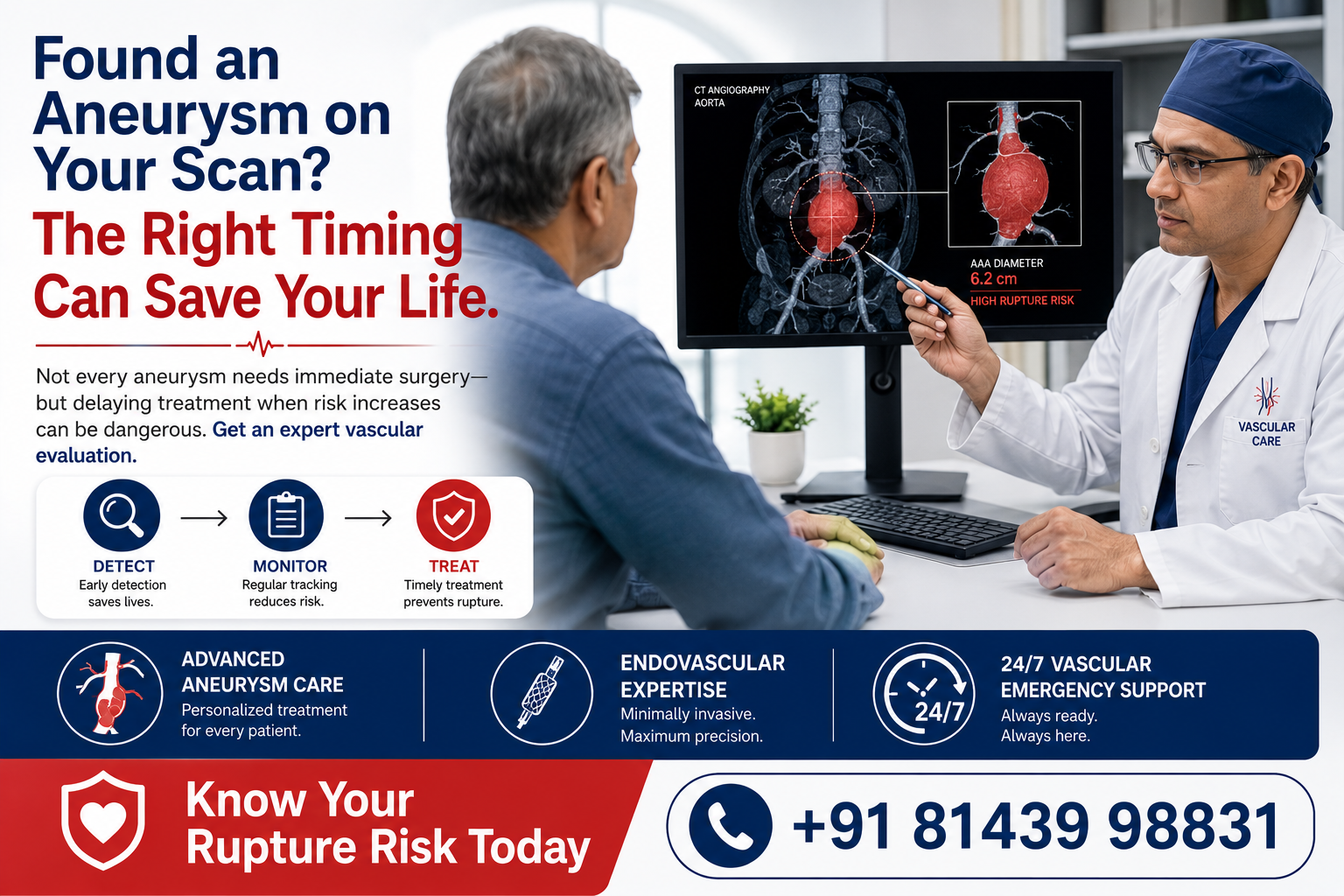
“My Scan Shows an Aneurysm. Do I Need Surgery Right Now?”
This is often the first question patients ask after discovering they have an aneurysm.
The word itself can be alarming. Many people immediately think about rupture, emergency surgery, or life-threatening complications. However, the reality is more nuanced.
Some aneurysms can be safely monitored for years. Others require prompt treatment because the risk of rupture increases significantly over time.
The challenge is knowing the difference.
Understanding aneurysm surgery, the factors that influence aneurysm size risk, and the warning signs that should never be ignored can help patients make informed decisions before an emergency occurs.
When Is Aneurysm Surgery Necessary?
Aneurysm surgery is usually recommended when an aneurysm reaches a size associated with increased rupture risk, grows rapidly, causes symptoms, or shows signs of instability on imaging. The decision depends on aneurysm size risk, location, overall health, and specialist evaluation.
Why Aneurysms Are Often Called “Silent Threats”
An aneurysm develops when a weakened area of an artery wall begins to bulge outward under pressure.
The concern is not the aneurysm itself.
The concern is what happens if it continues to enlarge.
Many patients experience:
- No pain
- No visible symptoms
- No warning signs
This is why aneurysms are frequently discovered during scans performed for unrelated health issues.
The Number Every Patient Wants to Know: How Big Is Too Big?
One of the most important factors doctors evaluate is aneurysm size risk.
Generally speaking:
Lower-Risk Aneurysms
- Small in size
- Stable over time
- No symptoms
- No rapid growth
Higher-Risk Aneurysms
- Larger diameter
- Progressive enlargement
- Structural weakness
- Associated symptoms
As aneurysms grow larger, the pressure on the vessel wall increases, making aneurysm surgery more likely to be recommended.
It’s Not Just About Size
Many patients focus entirely on measurements.
While aneurysm size risk is extremely important, specialists also assess:
Growth Speed
A rapidly enlarging aneurysm may require treatment even before reaching a critical size.
Location
Certain aneurysm locations carry a higher risk of complications.
Symptoms
Pain, pressure, or circulation problems can indicate increasing instability.
Overall Health
Treatment decisions must balance rupture risk against surgical risk.
This personalized approach is why two patients with similar aneurysm sizes may receive different recommendations.
Symptoms That Should Never Be Ignored
Although many aneurysms remain silent, some produce warning signs.
Possible symptoms include:
🚨 Persistent abdominal pain
🚨 Unexplained back pain
🚨 Pulsating sensation in the abdomen
🚨 Chest discomfort
🚨 Sudden circulation problems in the legs
Any new or worsening symptoms should be evaluated promptly.
The Biggest Mistake Patients Make
One of the most common misconceptions is:
“I don’t have symptoms, so I don’t need treatment.”
Unfortunately, aneurysm rupture often occurs without significant warning.
Waiting until symptoms become severe may reduce treatment options and increase risks.
This is why monitoring schedules and follow-up imaging are so important.
Modern Aneurysm Surgery Is Very Different Than It Used To Be
Many patients still imagine large incisions and lengthy hospital stays.
Today’s vascular care offers advanced treatment options that are often less invasive.
Endovascular Aneurysm Repair (EVAR)
This minimally invasive form of aneurysm surgery involves placing a specialized graft inside the artery using catheter-based techniques.
Benefits may include:
- Smaller incisions
- Reduced recovery time
- Less discomfort
- Earlier return to normal activities
Open Surgical Repair
For certain complex aneurysms, traditional surgery remains the best option and provides durable long-term results.
The ideal approach depends on anatomy, location, and aneurysm size risk.
How Doctors Determine Whether Surgery Is Needed
Before recommending aneurysm surgery, vascular specialists perform detailed evaluation.
Common investigations include:
✔ CT Angiography
✔ Doppler Ultrasound
✔ Advanced Vascular Imaging
✔ Blood Flow Assessment
These tests help answer critical questions:
- How large is the aneurysm?
- Is it growing?
- Is rupture risk increasing?
- What treatment offers the safest outcome?
A Real-World Example
A 67-year-old patient underwent a routine health check and was unexpectedly diagnosed with an abdominal aneurysm.
Initially, monitoring was recommended.
Over the next year, imaging showed progressive enlargement and increasing aneurysm size risk.
Rather than waiting for symptoms or rupture, the patient underwent planned aneurysm surgery using a minimally invasive endovascular approach.
The aneurysm was successfully repaired before becoming life-threatening.
This highlights an important principle:
The best aneurysm surgeries are often the ones performed before an emergency occurs.
When Should You Consult a Vascular Specialist?
You should seek specialist evaluation if:
✔ An aneurysm has been detected on a scan
✔ Follow-up imaging has been delayed
✔ You have unexplained abdominal or back pain
✔ There is a family history of aneurysm disease
✔ You want a second opinion regarding treatment
Early assessment provides more options and often leads to better outcomes.
Why Patients Choose Asian Vascular Hospitals for Aneurysm Care
Aneurysm management requires experience, advanced imaging, and timely decision-making.
At Asian Vascular Hospitals, patients benefit from:
Dedicated Vascular Expertise
Focused care for complex artery and circulation disorders.
Advanced Diagnostic Imaging
Comprehensive aneurysm assessment using modern vascular technology.
Minimally Invasive Treatment Options
Including advanced endovascular aneurysm repair techniques.
24/7 Vascular Emergency Support
For urgent aneurysm-related complications.
Personalized Treatment Planning
Because every aneurysm carries a different level of risk.
📞 Don’t Wait Until an Aneurysm Becomes an Emergency
If you’ve been diagnosed with an aneurysm—or have concerns about aneurysm size risk—early evaluation can help determine whether monitoring or aneurysm surgery is the safest option.
Asian Vascular Hospitals is a dedicated vascular specialty center in Hyderabad led by Dr. G. V. Praveen Kumar, an experienced vascular surgeon with over 20 years of expertise and 30,000+ vascular procedures.
📍 Banjara Hills, Hyderabad
📞 Call Now: +91 81439 98831
🌐 www.asianvascularhospitals.com
🚑 24/7 Emergency Vascular Care Available
- All Post
- blog





Related posts:
 Vascular Surgeon Vijayawada – Advanced Care by Dr. G.V. Praveen Kumar
 Early Stage Diabetic Foot Ulcer – Catch It Before It Gets Serious
 🧠 Peripheral Neuropathy Test – Detect Nerve Damage Early & Protect Your Health
 Laser Treatment for Varicose Veins Near Me – Asian Vascular Hospitals
 🌟 Best Treatment for Peripheral Neuropathy – Asian Vascular Hospitals
 Vascular Surgeon in Medchal: Advanced Care for Healthy Circulation
 Diabetic Foot Shoes: Comfort & Protection for Every Step
 👣 Podiatrist Hyderabad – Expert Foot & Ankle Care at Asian Vascular Hospitals


One Response