

Medical Content Review
Medically Reviewed By: Dr. G.V. Praveen Kumar, Founder Chairman & Chief Consultant Vascular & Endovascular Surgeon, Asian Vascular Hospitals, Hyderabad
Qualifications: MBBS, MS, DNB (Vascular Surgery)
Clinical Experience: 20+ years of hands-on clinical experience in vascular and endovascular surgery
Medical Specialties: Peripheral Arterial Disease (PAD), endovascular interventions, angioplasty, thrombectomy, embolisation, diabetic foot management, limb salvage, aneurysm repair and vascular surgery
Last Medical Review: August 2026
Medical claims, treatment recommendations, and statistics in this article should be reviewed against current clinical guidelines before publication and during future content updates.
About the Medical Reviewer: Dr. G.V. Praveen Kumar is the Founder and Chief Vascular Surgeon at Asian Vascular Hospitals. His clinical profile includes peripheral arterial disease management and endovascular interventions, including angioplasty and thrombectomy.
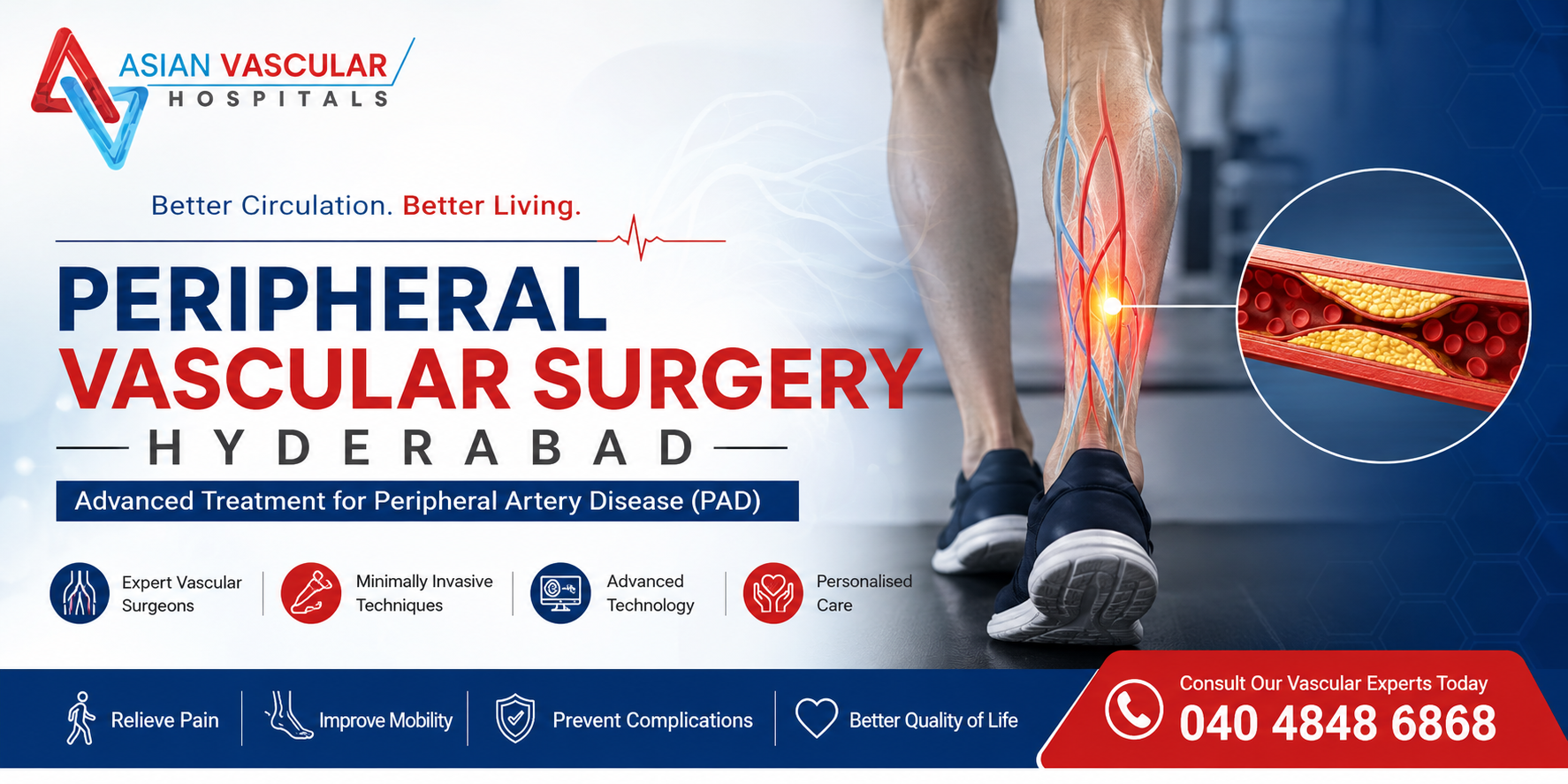
Peripheral artery disease (PAD) can develop gradually, and its early symptoms are sometimes mistaken for normal aging, muscle pain, or tiredness. A person may notice calf pain while walking and simply reduce physical activity rather than investigate the cause. But as blood flow becomes more restricted, PAD can affect mobility, wound healing, and, in advanced cases, the health of the limb.
If you’re searching for peripheral vascular surgery in Hyderabad or a peripheral vascular surgeon in Hyderabad, the first question isn’t necessarily whether you need surgery. The more important question is, how severe is the circulation problem, and which treatment is appropriate for your arteries?
Treatment may include lifestyle changes, medication, and structured exercise, as well as minimally invasive procedures such as angioplasty and stenting, open bypass surgery, or a combination of approaches. The appropriate option depends on the location and severity of the blockage, symptoms, overall health, and whether the limb is at risk.
This guide explains what PAD is, how it is diagnosed, when revascularization may be needed, the main treatment options available, and what patients should consider when choosing a vascular specialist in Hyderabad.
Quick Answer: What Is Peripheral Vascular Surgery in Hyderabad?
Peripheral vascular surgery in Hyderabad refers to surgical and minimally invasive treatments used to restore blood flow through narrowed or blocked peripheral arteries, particularly those supplying the legs. Depending on the severity and location of the blockage, treatment may include medical management and exercise, angioplasty, stenting, bypass surgery or a hybrid procedure.
Not every patient with peripheral artery disease needs surgery. Some patients can be managed with medication, risk-factor control and structured exercise. Revascularization may be considered when symptoms remain significantly limiting despite appropriate treatment or when severe circulation problems threaten the limb.
PAD treatment at a glance
| Patient Situation | Possible Management |
|---|---|
| No or Mild Symptoms | Risk-Factor Management, Medication and Monitoring |
| Walking Pain Affecting Daily Activities | Structured Exercise and Medical Treatment; Revascularization May Be Considered if Symptoms Persist |
| Significant Arterial Narrowing | Angioplasty, Stenting or Bypass May Be Considered Depending on Anatomy |
| Non-Healing Wound or Tissue Loss | Prompt Vascular Assessment and Possible Revascularization |
| Sudden Severe Pain, Coldness, Numbness or Weakness | Emergency Vascular Assessment |
The final treatment decision should be made after a clinical examination and appropriate vascular testing.
What Is Peripheral Artery Disease?
Peripheral artery disease is a condition in which arteries supplying the limbs—most commonly the legs—become narrowed or blocked. Atherosclerosis, or plaque buildup inside the artery wall, is a common cause.
When blood flow is reduced, the muscles and tissues of the leg may not receive enough oxygen, particularly during physical activity. PAD can also be associated with increased cardiovascular and limb-related risks. The 2024 ACC/AHA guideline describes PAD in four clinical presentations: asymptomatic PAD, chronic symptomatic PAD, chronic limb-threatening ischemia, and acute limb ischemia.
Common symptoms of PAD
Symptoms aren’t always obvious. Some people have no noticeable symptoms, while others may experience the following:
- Calf, thigh, buttock or foot pain while walking
- Leg fatigue, heaviness or cramping
- Pain that improves after resting
- Numbness or weakness in a leg or foot
- One foot feeling colder than the other
- Changes in skin colour
- Slow-growing toenails or reduced leg hair
- Foot or leg wounds that heal slowly
- Pain in the foot or leg while resting in advanced disease
Walking-related pain caused by reduced blood flow is commonly called intermittent claudication. More advanced PAD can cause persistent rest pain, non-healing wounds, or tissue damage.
A wound that doesn’t heal, particularly in a person with diabetes, shouldn’t be treated as an ordinary skin problem. Poor circulation can interfere with healing and increase the risk of infection and tissue damage.
When Should You See a Peripheral Vascular Surgeon in Hyderabad?
Not every person with PAD needs an operation. In many cases, initial management focuses on controlling cardiovascular risk factors, improving walking ability, using appropriate medicines, and following a structured exercise program.
A vascular specialist becomes particularly important when symptoms are persistent, worsening, or interfering with normal activities.
Situations that warrant vascular evaluation
Consider seeing a vascular specialist if you have:
- Repeated leg pain when walking that limits normal activity
- A foot or toe wound that heals slowly
- Persistent pain in the foot at rest
- Sudden changes in foot temperature or colour
- Significant numbness or weakness
- Known vascular disease with worsening symptoms
- Diabetes accompanied by foot wounds or circulation concerns
- Imaging that has already shown significant arterial narrowing or blockage
A sudden onset of severe leg pain, coldness, pale or bluish skin, numbness, or weakness can indicate acute limb ischemia. This is an emergency and requires immediate medical assessment rather than waiting for a routine appointment.
How Is Peripheral Artery Disease Diagnosed?
Before recommending peripheral vascular surgery in Hyderabad, a vascular specialist needs to determine where the circulation problem is and how severe it is.
Diagnosis generally begins with a medical history and physical examination, followed by appropriate vascular testing.
Step 1: Clinical assessment
The doctor reviews symptoms, walking limitations, medical history, and cardiovascular risk factors. The examination may include checking pulses in the legs and feet and looking for wounds, skin changes, or other signs of reduced circulation.
Step 2: Ankle-Brachial Index
The ankle-brachial index (ABI) compares blood pressure measured at the ankle with blood pressure measured at the arm. It is a commonly used non-invasive test for detecting PAD.
Step 3: Additional vascular testing
Depending on the clinical situation and ABI findings, additional physiological tests may be recommended. These can include toe-brachial index testing or exercise ABI testing.
Step 4: Vascular imaging
Duplex ultrasound, CT angiography, MR angiography, or catheter angiography may be used when the doctor needs a clearer picture of the arterial anatomy, particularly when revascularization is being considered.
The purpose of these investigations isn’t simply to find a blockage. The vascular team needs to understand where the blockage is, how extensive it is, what vessels are available beyond it, and which treatment is most appropriate for the patient.
A scan showing an arterial blockage does not automatically mean that surgery is required.
Peripheral Vascular Surgery Hyderabad: What Treatment Options Are Available?
The term “vascular surgery” can make patients think immediately of open surgery. In modern vascular care, treatment can include medical management, catheter-based procedures, open surgery, or hybrid approaches.
There is no single best procedure for every patient. Treatment is selected according to the severity of symptoms, location and extent of arterial disease, blood-flow requirements, other medical conditions, previous procedures, and the expected benefit of intervention.
1. Medical treatment and structured exercise
For many patients, the first step isn’t surgery.
Treatment may include prescribed medicines, cholesterol management, blood-pressure control, diabetes management, smoking cessation, and structured exercise. Medical management remains an important part of PAD care even when a procedure is eventually required.
A structured walking program can improve walking ability and reduce limitations caused by claudication.
2. Angioplasty
Angioplasty is a minimally invasive procedure used to widen a narrowed or blocked artery.
A thin catheter is guided through the blood vessel to the affected area. A small balloon may then be inflated to improve the opening within the artery. In selected cases, a stent may be placed to help maintain the vessel’s openness.
Angioplasty may be considered when the arterial anatomy is suitable and the expected benefit outweighs the risks.
3. Peripheral arterial stenting
A stent is a small mesh-like structure placed inside an artery to help keep it open after treatment.
Whether a stent is appropriate depends on factors such as:
- The artery involved
- Length and location of the blockage
- Degree of narrowing
- Vessel anatomy
- Previous vascular procedures
- Overall health and procedural risk
The treating specialist should explain why a particular technique or device is appropriate rather than assuming every arterial blockage requires a stent.
4. Peripheral artery bypass surgery
Bypass surgery creates an alternative route around a blocked section of an artery.
The surgeon may use a suitable vein from the patient’s body or a synthetic graft to create a new pathway for blood flow. Bypass can be considered in selected patients with severe or complex disease, particularly when an endovascular approach is unlikely to provide an adequate result.
Because bypass is a more involved operation than angioplasty, the patient’s overall health, arterial anatomy, and expected benefit need to be considered carefully.
5. Hybrid vascular procedures
Some patients have complex disease involving multiple arterial segments. A vascular team may use a combination of open surgical and endovascular techniques. This is known as a hybrid approach.
The goal isn’t simply to select the newest or most advanced procedure. The objective is to restore sufficient blood flow while considering safety, durability, recovery, and the patient’s individual circumstances. Current PAD guidance recognizes endovascular, surgical, and hybrid revascularization as treatment approaches for appropriate patients.
When Is Peripheral Vascular Surgery Actually Needed?
Revascularization is generally considered when the expected benefit of restoring blood flow is greater than the risks of the procedure.
For patients with chronic limb-threatening ischemia, which can involve severe ischemic rest pain, non-healing wounds, or tissue loss, revascularization may be necessary to improve blood flow and help prevent limb loss. For patients with intermittent claudication, revascularization may be considered when symptoms remain significantly limiting despite appropriate medical treatment and structured exercise.
The distinction is important: a blocked artery on a scan does not automatically mean that surgery is required.
A practical example
Consider two patients with similar-looking arterial narrowing.
Patient A has mild calf discomfort after prolonged walking, no wounds, and symptoms that are improving with exercise and medical treatment.
Patient B has diabetes, persistent foot pain at rest and a toe wound that hasn’t healed.
Both may have PAD, but their clinical priorities are different. Patient A may initially continue with guideline-directed medical treatment and structured exercise. Patient B needs prompt vascular assessment because rest pain and a non-healing wound can indicate advanced ischemia and may require evaluation for revascularization.
This is why treatment decisions should be based on the patient’s symptoms, clinical findings and arterial anatomy—not the scan alone.
What Evidence Says About PAD Treatment
Current evidence-based recommendations emphasize that PAD treatment isn’t limited to opening an artery.
The 2024 ACC/AHA guideline recommends comprehensive management addressing cardiovascular risk. Depending on the patient, this can include appropriate antiplatelet or antithrombotic therapy, lipid lowering, blood-pressure management, diabetes management, smoking cessation, and structured exercise.
The same guideline recommends revascularization for patients with chronic limb-threatening ischemia to help prevent limb loss and supports revascularization for selected patients with functionally limiting claudication that has not responded adequately to medical therapy and structured exercise.
For patients researching peripheral vascular surgery Hyderabad, this provides an important takeaway: PAD treatment is broader than surgery, and revascularization should be selected for the right clinical situation.
When Does Peripheral Artery Disease Become an Emergency?
A patient shouldn’t wait for a routine consultation if circulation suddenly deteriorates.
Seek emergency medical attention for:
- Sudden severe leg or foot pain
- A suddenly cold foot
- Pale, blue or markedly changed skin colour
- New numbness
- New weakness or inability to move the limb
- Sudden loss of a previously detectable pulse
These symptoms can indicate acute limb ischemia, which requires urgent assessment and, when appropriate, rapid restoration of blood flow.
A separate concern is a non-healing foot wound. In patients with PAD, poor blood supply can interfere with wound healing and increase the risk of tissue damage and infection.
What to Expect Before and After Peripheral Vascular Surgery
Preparation and recovery vary significantly between angioplasty, stenting, and bypass surgery.
Before a procedure, the vascular team may review:
- Current medicines
- Diabetes and blood-sugar control
- Blood pressure and cholesterol
- Kidney function
- Smoking history
- Previous vascular procedures
- Imaging results
- Ability to walk and perform daily activities
Patients should tell their medical team about all prescribed medicines and supplements. They should not independently stop blood-thinning or antiplatelet medication unless their doctor instructs them to do so.
Recovery after treatment
Recovery depends on the procedure and the patient’s general health.
A catheter-based intervention may involve a shorter recovery than open bypass surgery, while bypass generally requires more healing and rehabilitation.
After treatment, follow-up remains important. Restoring blood flow does not remove the underlying tendency toward atherosclerosis.
Long-term care may involve:
- Prescribed vascular medicines
- Regular physical activity
- Blood-pressure management
- Cholesterol management
- Diabetes control
- Smoking cessation
- Regular foot inspection
- Follow-up vascular assessments when recommended
Foot care is particularly important for people with PAD, especially when diabetes or previous wounds are involved.
How to Choose a Peripheral Vascular Surgeon in Hyderabad
When comparing specialists or hospitals, don’t judge your options only by procedure names or advertised technology.
A suitable vascular service should be able to evaluate the underlying circulation problem, interpret vascular imaging, discuss non-surgical options, and explain why a particular intervention is being considered.
For complex PAD, coordinated care may involve vascular surgery, endovascular specialists, cardiology, diabetes care, wound care, and foot care professionals.
Questions to ask your vascular surgeon
Before agreeing to a procedure, consider asking:
- Where exactly is my arterial blockage?
- How severe is the blockage?
- Is my condition stable or limb-threatening?
- Do I need an intervention now?
- Can medication and structured exercise be tried first?
- Why are you recommending angioplasty, stenting, or bypass?
- What are the alternatives?
- What are the major risks of the proposed procedure?
- How long might recovery take?
- What follow-up and lifestyle changes will I need afterward?
These questions encourage shared decision-making rather than focusing only on the name of the procedure.
A good consultation should leave you understanding not only what procedure is being proposed but also why it is being recommended and what alternatives are available.
Local relevance for Hyderabad
For patients in Hyderabad, access to appropriate vascular imaging, endovascular treatment, vascular surgery, wound care, and follow-up can be particularly valuable when PAD is advanced or complicated by diabetes.
Frequently Asked Questions About Peripheral Vascular Surgery Hyderabad
What does a peripheral vascular surgeon treat?
A peripheral vascular surgeon treats diseases affecting blood vessels outside the heart and brain, including arterial blockages in the legs and other circulation disorders. Treatment may involve medication, endovascular procedures, open surgery, or a combination of approaches.
Is peripheral artery disease always treated with surgery?
No. Many people with PAD are initially managed with medical treatment, risk-factor control, and structured exercise. Revascularization may be considered when symptoms remain significantly limiting or when severe circulation problems threaten the limb.
Is angioplasty better than bypass surgery for PAD?
Neither procedure is universally better. The choice depends on the location and extent of arterial disease, vessel anatomy, previous treatment, overall health, and the goals of treatment.
Can PAD cause foot wounds?
Yes. Reduced blood flow can contribute to slow-healing wounds and, in severe disease, tissue loss and infection. A non-healing foot or toe wound—especially in a person with diabetes—should receive prompt medical evaluation.
When is peripheral vascular disease an emergency?
Sudden severe leg pain accompanied by a cold, pale, or bluish foot; numbness; weakness; or loss of circulation can indicate acute limb ischemia. This requires urgent medical attention because rapid treatment may be necessary to preserve the limb.
Key Takeaways About Peripheral Vascular Surgery Hyderabad
- PAD can be treated without surgery in many patients.
- ABI is an important non-invasive test used in PAD evaluation.
- Angioplasty and stenting may be suitable for selected arterial blockages.
- Bypass surgery may be considered for severe or complex disease when an endovascular approach isn’t suitable or effective enough.
- Non-healing wounds and rest pain require prompt vascular evaluation.
- Sudden severe pain, coldness, numbness, or weakness can indicate acute limb ischemia and requires emergency assessment.
- Long-term PAD care includes cardiovascular risk reduction even after a successful procedure.
- The right treatment depends on the individual patient’s symptoms, anatomy, health, and treatment goals.
Clear AI-Extraction Summary
Peripheral vascular surgery in Hyderabad is used to treat selected cases of peripheral artery disease when reduced blood flow causes significant symptoms or threatens the limb. Treatment may include medical management and structured exercise, angioplasty, stenting, bypass surgery, or hybrid revascularization. Diagnosis commonly begins with clinical assessment and ABI testing, followed by vascular imaging when intervention is being considered. Patients with non-healing wounds, rest pain, or signs of acute limb ischemia need prompt vascular assessment.
Conclusion
Peripheral artery disease should not be judged by the presence of a blockage alone. The severity of symptoms, blood-flow limitation, wound status, cardiovascular health, and the anatomy of the affected arteries all influence the appropriate treatment.
For someone searching for peripheral vascular surgery in Hyderabad, the sensible next step is a proper vascular assessment rather than assuming that angioplasty or bypass surgery is automatically necessary. Depending on the condition, treatment may involve lifestyle changes and medication, angioplasty or stenting, bypass surgery, or a hybrid approach.
If you’re experiencing persistent walking-related leg pain, a non-healing foot wound, rest pain, or other circulation changes, consider consulting a qualified vascular specialist in Hyderabad. Early assessment can help identify the cause and determine the most appropriate treatment.